TL;DR:
The 2025 Medicine and Pediatric Specialties Match saw record participation, growing subspecialty demand, and notable shifts in applicant trends across Internal Medicine, Pediatrics, Addiction Medicine, and multidisciplinary fields. With more than 10,800 active applicants competing for just under 10,000 fellowship positions, this year’s match signals a more competitive landscape—and one where relocation planning matters more than ever for fellows and early-career physicians.
The Ultimate Breakdown of the 2025 Medicine & Pediatric Specialties Match (for Physicians Planning Their 2026 Move)
Each December, thousands of physicians take their next major career step as they match into subspecialty training programs across the country. For many, this match isn’t just a professional milestone—it’s the moment they officially know where they will build a life for the next several years.
At ReloDoc, we track the NRMP’s Medicine & Pediatric Specialties Match closely because the data tells us where demand is rising, which cities are likely to see surges in physician relocation, and how competitive the pathway is for different specialties. This year’s numbers tell a compelling story.
According to the NRMP’s official press release and the 2025 appointment-year infographic, the Medicine & Pediatric Specialties Match continues to grow on both the applicant and program sides.
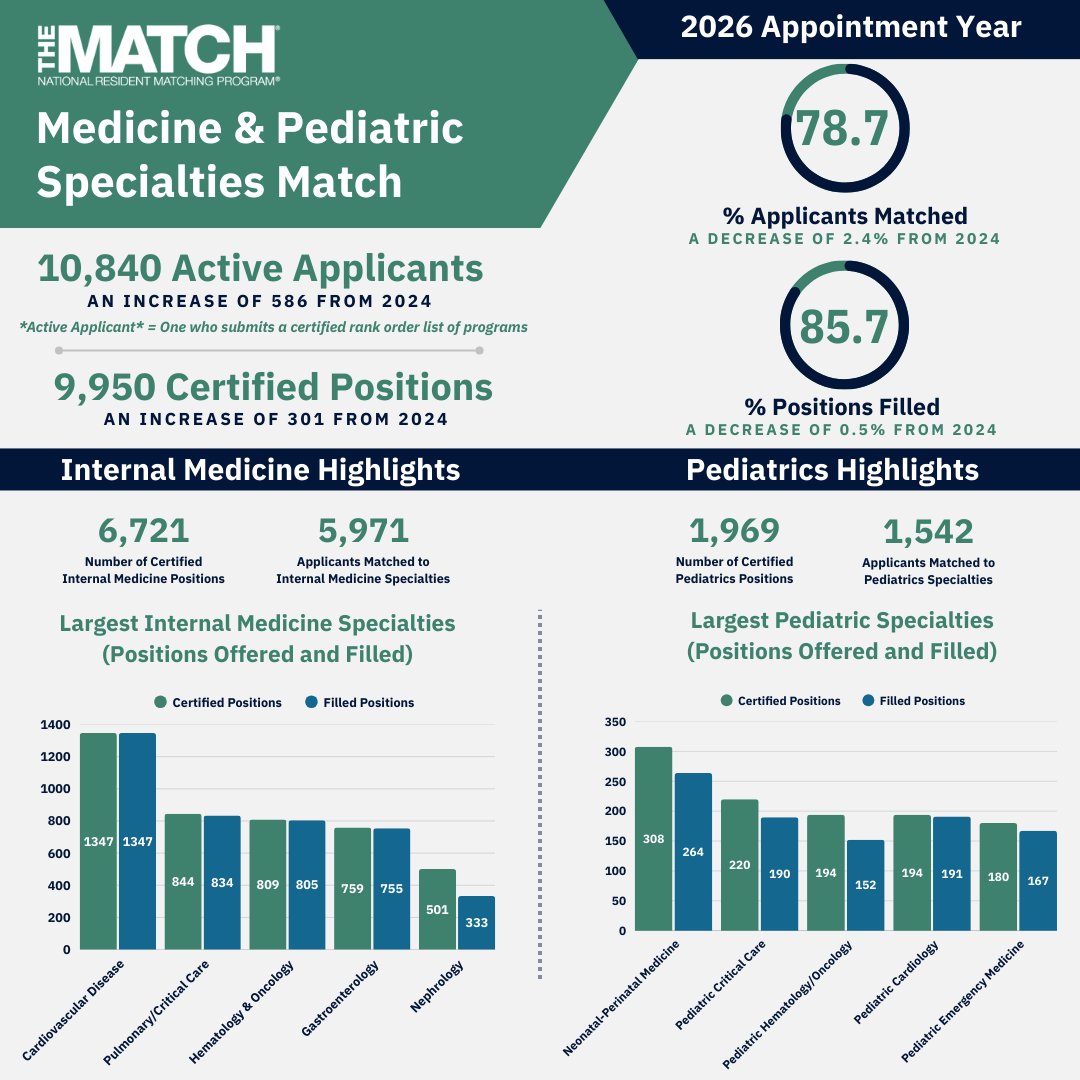
2025 Match at a Glance
8,526 physicians matched into fellowship programs for the 2026 appointment year—the largest total in the Specialties Matching Service.
10,840 active applicants
Up 586 from last year, showing sustained demand for subspecialty training.
9,950 certified fellowship positions
Up 301 from 2024.
85.7% of positions filled
A slight decrease from the previous year, driven largely by challenges in specific specialties.
78.7% applicant match rate
Down 2.4 percentage points despite more applicants participating.
Visual highlights from the infographic reinforce these trends, including applicant totals, fill rates, and the largest specialties in Internal Medicine and Pediatrics (see page 1).
Internal Medicine Subspecialties: Cardiovascular and GI Continue to Dominate
Internal Medicine remains the largest portion of this fellowship match, with:
-
6,721 certified positions
-
5,971 positions filled (88.8% fill rate)
Internal Medicine’s biggest—and most competitive—subspecialties filled nearly all positions:
-
Cardiovascular Disease: 1,347 positions, 100% filled
-
Gastroenterology: 759 positions, 99.5% filled
-
Hematology/Oncology: 809 positions, 99.5% filled
-
Pulmonary/Critical Care: 844 positions, 98.8% filled
-
Rheumatology: 302 positions, 99% filled
These areas historically correlate with major academic centers, higher patient volumes, and robust transplant/oncology/cardiac service lines—making them key relocation markets for 2026.
Notably, Adult Infectious Disease continues to face declining interest, filling just 60.9% of positions—down more than nine percentage points from last year.
Pediatric Subspecialties: Growth with Uneven Distribution
Pediatrics saw:
-
1,969 certified positions
-
1,542 filled (78.3% fill rate), a slight improvement over 2024
High-demand pediatric subspecialties with 95%+ fill rates included:
-
Pediatric Cardiology: 98.5% filled
-
Pediatric Gastroenterology: 96% filled
The infographic highlights the largest pediatric fields—Neonatal-Perinatal Medicine, Pediatric Critical Care, Heme/Onc, Cardiology, and Emergency Medicine—most of which saw strong fill performance despite smaller cohort sizes.
Pediatrics overall remains a smaller but highly relational market, often concentrated around children’s hospitals and pediatric research hubs—settings where relocation support can make an outsized difference for families.
Multidisciplinary Specialties: Consistent Demand, Uneven Fill Rates
Across Allergy/Immunology, Sleep Medicine, and Hospice & Palliative Medicine:
-
877 certified positions
-
763 filled (87% fill rate)
Allergy/Immunology continues to be extremely competitive, filling 98.9% of positions.
Applicant Trends Worth Noting
Despite an increasingly competitive environment, the mix of applicant backgrounds continues to shift:
-
MD graduates: 4,618 applicants; 89% match rate
-
DO graduates: 1,728 applicants; 78% match rate (significant growth from 2024)
-
U.S. citizen IMGs: 1,593 applicants; 65% match rate
-
Non-U.S. IMGs: 2,892 applicants; 70% match rate
For Internal Medicine subspecialties, non-U.S. IMGs represented over 28% of matched applicants, indicating the field’s broad international pipeline.
For Pediatrics, DO graduates made up the second-largest group of matched applicants, highlighting the field’s expanding training pathways.
Couples matching remained steady at 129 pairs, reinforcing how important geographic alignment—and relocation logistics—remain for dual-physician households.
Specialties Facing Persistent or Growing Workforce Challenges
Some of the most pressing trends include:
1. Adult Infectious Disease
A significant decline to 60.9% filled. This has major implications for hospitals nationwide still recovering from pandemic-era workforce strain.
2. Geriatric Medicine
Despite an aging population, interest continues to drop. Only 37% of positions filled—one of the steepest declines across all specialties.
3. Addiction Subspecialties
Mixed performance:
-
Addiction Medicine: More positions offered, but fill rate dropped to 63.8%
-
Addiction Psychiatry: Fewer positions offered, but fill rate increased to 68.8%—the best the field has seen in three years
These fluctuations point to shifting training interest and evolving institutional support for behavioral health and chronic disease management.
What This Means for Physicians Planning a Move in 2026
Relocation is now a strategic component of fellowship planning—not a post-match afterthought.
Here are the trends that matter most for relocating physicians:
1. Markets with major academic centers will stay highly competitive.
Cardiology, GI, Heme/Onc, and Pulm/Critical Care continue to cluster around top medical systems. Housing demand near these centers often surges from February through August as incoming fellows secure rentals and starter homes.
2. Pediatric subspecialty hubs remain concentrated in fewer cities.
This increases the importance of early planning—especially for families balancing childcare, schools, or multi-year employment plans.
3. IMG-heavy specialties require more logistical guidance.
Credentialing, visa timelines, and housing access can intersect in complex ways. Early preparation is key to avoiding delays.
4. Dual-physician couples should expect tighter geographic constraints.
With couples matching holding steady, the need for well-coordinated relocation and home-search support is higher than ever.
5. Markets with low fill-rate specialties may experience workforce gaps.
Regions struggling to attract fellows—especially in Geriatrics and Infectious Disease—may offer stronger incentives but also require more targeted evaluation when considering long-term fit.
How ReloDoc Supports Physicians During Fellowship Relocation
Whether you matched in Cardiology, Pediatric Critical Care, Allergy/Immunology, or a more niche subspecialty, one constant remains:
You’re navigating a high-stakes move with limited time.
ReloDoc exists to simplify that transition.
We help physicians:
-
Understand neighborhood fit, commute times, hospital proximity, and cost-of-living differences
-
Evaluate buy vs. rent decisions based on timeline and financial considerations
-
Coordinate local tours for fellowship candidates and their families
-
Connect with physician-friendly lenders (including specialized loan products)
-
Relocate again if their career transitions post-fellowship
With match results in hand, now is the ideal time to begin planning your move.
If You Matched to Pittsburgh—Welcome to the ‘Burgh
Pittsburgh remains a national leader in subspecialty training, driven by UPMC’s broad fellowship offerings and AHN’s expanding programs. Whether you’re joining Cardiology, GI, PCCM, Pediatric Heme/Onc, or another specialty, we would be honored to help you make Pittsburgh feel like home.
If you matched elsewhere but want relocation support in your destination city, we can connect you with trusted, physician-friendly partners nationwide through the ReloDoc network.
Ready to Start Planning Your Fellowship Move?
Contact ReloDoc to begin your personalized relocation consultation.
Your career is specialized—your move should be, too.